Running a barbershop comes with one constant: electricity must be stable. Clippers, lights, fans, AC, CCTV, point-of-sale systems — everything depends on reliable power. But with rising energy costs and unstable grid supply in many parts of Africa, barbers are turning to solar.
Sizing a solar system for a small barbershop is not complicated — as long as you follow the right steps. This guide breaks it down in a simple, practical way.
Identify the Essential Loads
Every barbershop has two types of loads:
A. Constant/Essential Loads
These are always ON during business hours:
- Clippers
- LED lights
- Ceiling fan or standing fan
- Phone chargers
- POS system
- Music player
- Small TV
B. High-Power/Occasional Loads
These only run sometimes:
- Towel warmer
- Air conditioner (1 hp)
For most small barbershops, essential loads are the primary focus.
2. Calculate Daily Energy Consumption
To size a solar power system, you need one number:
Daily Energy Consumption (Wh per day) = Power (W) × Run Time (Hours)
Here’s a load analysis table for a small barbershop
| S/N | DESCRIPTION | QTY | POWER(W) | TOTAL POWER(W) | RUN-TIME(HOURS) | DAILY ENERGY CONSUMPTION(WH) |
| 1 | Clipper | 1 | 15 | 15 | 6 | 90 |
| 2 | LED bulbs | 4 | 10 | 40 | 6 | 240 |
| 3 | Television | 1 | 60 | 60 | 6 | 360 |
| 4 | Decoder | 1 | 18 | 18 | 6 | 108 |
| 5 | Music player | 1 | 40 | 40 | 6 | 240 |
| 6 | Ceiling fan | 1 | 36 | 36 | 6 | 216 |
| TOTAL | 209 | 1,254 |
Please note:
I choose 6 hours run time per day for all the loads because from 5PM to 10PM the sun will not be available. The loads at this time will be powered by the energy that is stored in the battery. I will also take into consideration the energy that is needed to power the loads from 8AM to 4PM.
Sizing the Inverter:
Size of inverter = Total power(W) ÷ 0.8
209W ÷ 0.8 = 261.25W.
For this barbershop, I will use 1.6kW/12V hybrid inverter. I will give you my reason for this later.
Sizing the battery bank:
Step 1:
Divide total daily energy consumption by inverter efficiency
1,254Wh ÷ 0.9 = 1,393.3Wh
Step 2:
Add inverter standby consumption. The standby consumption for the 1.6kW hybrid inverter is 25W.
25W x 6H = 150Wh
1,393.3Wh + 150Wh = 1,543.3Wh
Step 3:
Multiply by days of autonomy. Here, we will use 1 day of autonomy.
1,543.3Wh x 1 = 1,543.3Wh
Step 4:
Divide by temperature compensation factor
1,543.3Wh ÷ 0.9 = 1,715Wh
Step 5:
Divide by depth of discharge (DoD). The DoD is 80% since it’s a lithium battery
1,715Wh ÷ 0.8 = 2,144Wh
Step 6:
Divide by nominal system voltage
2,144Wh ÷ 12.8V = 167.5Ah. This is approximately 200Ah
To know the energy that is stored in the 200Ah battery, multiply the battery capacity in Ah by the battery nominal voltage
200Ah x 12.8V = 2,560Wh or 2.56kWh
Sizing the solar panels:
To size the solar panels, we will take the value from step two when sizing the battery bank. The value is 1,543.3Wh
Step 1:
Divide the above value by performance ratio
1,543.3Wh ÷ 0.65 2,374.3Wh
Step 2:
Divide by peak sun hours. I am using the lowest value for my location which is 2.5 hours
2,374.3Wh ÷ 2.5H = 949.72W
Step 3:
Divide by the solar panel power rating. Here, I will use 600W solar panel
949.72W ÷ 600W = 1.6pcs
I will approximate to 2pcs
Since the barber will also use these loads during the day, I will account for this also. Remember that the total power rating of all the loads is 209W. To sufficiently charge the battery and also power daytime loads, I will increase the solar panels to 3 pcs.
During sunny days, the solar panels will generate enough energy. With this, the barber can power a small fridge/freezer and towel warmer.
Reason I choose the 1.6kW/12V hybrid inverter:
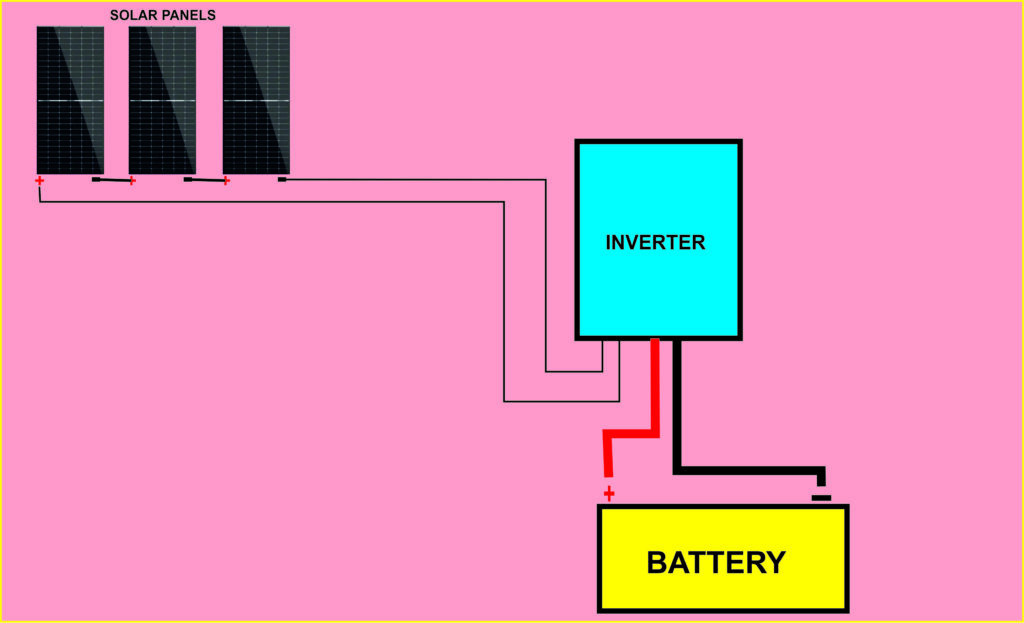
The 1.6kW inverter can handle up to 2000W of PV power which a 500W or 1000W inverter cannot handle. This fits perfectly well for my system design.
Other accessories/components
Breakers:
AC (between inverter and loads) – 10A
DC (between battery and inverter) – 100A
Cables:
AC (between inverter and loads) – 2.5mm2
DC (between battery and inverter) – 35mm2
Solar panels to hybrid inverter – 4mm2
Breaker size between solar panels and inverter – 30A
Conclusion
Sizing a solar system for a small barbershop is simple when you break it down into:
- What equipment you use
- How long you use it
- How much energy it consumes daily
- How much battery + solar you need to sustain it
Watch video on Youtube: https://youtu.be/QGh3UzqSf7M?si=4x3HZny59x-abn19
Buy pdf on solar system sizing here: https://selar.com/75oj77
Leave a Reply